UK Prime Minister Theresa May will notify European Council President Donald Tusk on March 29 that she wishes to activate Article 50 and beg...

UK Prime Minister Theresa May will notify European Council President Donald Tusk on March 29 that she wishes to activate Article 50 and begin the process of negotiating the UK's withdrawal from the EU


The Lisbon Treaty was signed by the heads of state and government of the 27 EU Member States on 13 December 2007. It is intended to reform the functioning of the European Union following the two waves of enlargement which have taken place since 2004 and which have increased the number of EU Member States from 15 to 27.

Article 50 - The Lisbon Treaty

1. Any Member State may decide to withdraw from the Union in accordance with its own constitutional requirements.

2. A Member State which decides to withdraw shall notify the European Council of its intention. In the light of the guidelines provided by the European Council, the Union shall negotiate and conclude an agreement with that State, setting out the arrangements for its withdrawal, taking account of the framework for its future relationship with the Union. That agreement shall be negotiated in accordance with Article 218(3) of the Treaty on the Functioning of the European Union. It shall be concluded on behalf of the Union by the Council, acting by a qualified majority, after obtaining the consent of the European Parliament.

3. The Treaties shall cease to apply to the State in question from the date of entry into force of the withdrawal agreement or, failing that, two years after the notification referred to in paragraph 2, unless the European Council, in agreement with the Member State concerned, unanimously decides to extend this period.

4. For the purposes of paragraphs 2 and 3, the member of the European Council or of the Council representing the withdrawing Member State shall not participate in the discussions of the European Council or Council or in decisions concerning it.

A qualified majority shall be defined in accordance with Article 238(3)(b) of the Treaty on the Functioning of the European Union.

5. If a State which has withdrawn from the Union asks to rejoin, its request shall be subject to the procedure referred to in Article 49.

US New Home Sales (Feb) M/M 592K vs. Exp. 559K (Prev. 555K, Rev. 558K) US New Home Sales (Feb) M/M 592K vs. Exp. 559K (Prev. 555K, ...


US New Home Sales (Feb) M/M 592K vs. Exp. 559K (Prev. 555K, Rev. 558K)

From Nomura:

“Initial jobless claims: Initial claims remain at historically low levels after a continued decline during the recovery. For the week ending 11 March, the 4-week average of initial claims was at 237k, up only marginally from the prior week. As labor market conditions remain healthy, we continue to expect this series to remain low.” “New home sales: New home sales rebounded in January, increasing 3.7% to an annualized rate of 555k. However, incoming data suggest some moderation in this series in February. Sales of single family homes index in the National Association of Home Builders (NAHB) housing survey inched downward slightly, but remained at an elevated level. However, mortgage applications for home purchases fell modestly, in part, due to higher mortgage rates which picked up after the election. In addition, the latest NAHB report indicates that industry headwinds such as labor shortage and supply-side constraints still persist. Therefore, we forecast a 0.5% m-o-m increase to an annualized rate of 558k (Consensus: +1.8% to an annual rate of 565k).”

From Goldman:

Hard and soft data on the US housing market The economic indicators monitored by analysts can be roughly divided into soft data (e.g., sentiment and confidence surveys) and harder data (e.g., realized employment, production and sales measures). In the immediate aftermath of the November US presidential election, forward-looking sentiment indicators picked up solidly, in advance of actual gains in harder data ("Sentiment Ahead of Data", Global Markets Daily, January 17, 2017). The strong payrolls report in February is one example of a hard data point potentially validating the positive outlook manifested in consumer and business confidence surveys. The pattern of strong hard data following strong soft data could be a reflection of the forward-looking nature of the surveys, but could also partly reflect a causal connection, with strong "animal spirits" causing the pick-up in the harder data.

The Baker Hughes Rig Count was up 313% from the year prior - a surge in productions. Currently the U.S. rig count is at 631 (oil) and 157 ...


The Baker Hughes Rig Count was up 313% from the year prior - a surge in productions. Currently the U.S. rig count is at 631 (oil) and 157 (gas) rigs. This includes four horizontal rigs in Northern Alaska, bordering the Beaufort Sea.


Composite 11 Victoria: 3.2% Vancouver: 19.5% Calgary: 8.3% Edmonton: 5.2% Winnipeg: 2.2% Hamilton: 3.7% Toronto: 34.6% Ottawa-Gati...

Composite 11
Victoria: 3.2%
Vancouver: 19.5%
Calgary: 8.3%

Edmonton: 5.2%
Winnipeg: 2.2%
Hamilton: 3.7%
Toronto: 34.6%
Ottawa-Gatineau: 5.7%
Montréal: 14%

Québec: 2.1%
Halifax: 1.5%


Composite 6
Vancouver: 23.3%

Calgary: 9.9%
Toronto: 41.4%
Ottawa-Gatineau: 6.8%
Montréal: 16.8%
Halifax: 1.8%
http://www.housepriceindex.ca/

Oil is trapped in a sideways spiral. Despite so, relentless pursuits have treated this recent cycle like a binary issue. No matter what ...


Oil is trapped in a sideways spiral. Despite so, relentless pursuits have treated this recent cycle like a binary issue.

No matter what your conviction is oil has taken a beating. At this very moment WTI is not performing, but the global issues where demand and supply have been in flux is about to overturn, and many CEO's and investors are certain oil has hits its bottom. Again.

OPEC is looking for the perfect price, one that is substantial to keep investors excited and grown revenues, at the same time metering the costs so as not to encourage more shale drilling. Since the shorts are not piling up this may be a temporary price issue...OPEC may be cutting but they have hundreds of billions in upsteam investment planned over the next five years, That is evident is by OPEC's multi-hundred billion dollar upsteam investment program (see data).

On March 9th Goldman Sachs Energy Pulse stated: The industry appears to be using a wide spread of oil price assumptions in its strategy presentations, despite an almost completely flat forward curve. Goldman also forecasts a deficit throughout 2017.

What is reflation? Reflation is the act of stimulating the economy by increasing the money supply or by reducing taxes, seeking to bring ...

What is reflation?

Reflation is the act of stimulating the economy by increasing the money supply or by reducing taxes, seeking to bring the economy (specifically price level) back up to the long-term trend, following a dip in the business cycle. It is the opposite of disinflation, which seeks to return the economy back down to the long-term trend. Reflation, which can be considered a form of inflation (increase in the price level), is contrasted with inflation (narrowly speaking) in that "bad" inflation is inflation above the long-term trend line, while reflation is a recovery of the price level when it has fallen below the trend line. For example, if inflation had been running at a 3% rate, but for one year it falls to 0%, the following year would need 6% inflation (actually 6.09% due to compounding) to catch back up to the long-term trend. This higher than normal inflation is considered reflation, since it is a return to trend, not exceeding the long-term trend. This distinction is predicated on a theory of economic growth where there is long-term growth in the economy and price level, which is widely accepted in economics. Just as disinflation is considered an acceptable antidote to high inflation, reflation is considered to be an antidote to deflation (which, unlike inflation, is considered bad regardless of its magnitude) - Link


Reflation policy has been used by American governments, to try and restart failed business expansions since the early 1600s. Although almost every government tries in some form or another to avoid the collapse of an economy after a recent boom, none have ever succeeded in being able to avoid the contraction phase of the business cycle. Many academics actually believe government agitation only delays the recovery and worsens the effects. Read more: Reflation Definition | Investopedia 

The Securities Law Blog: SEC Wants All Investors to Access High Risk Invest... : In a startling about-face, Acting Securities and Exchange ...


The Securities Law Blog: SEC Wants All Investors to Access High Risk Invest...: In a startling about-face, Acting Securities and Exchange Commissioner Michael Piwowar called for allowing every investor to buy unregistered securities


Basically it allows anyone to invest in what pro's invest in, which is strange to allow. Also, since they are seeking to restrict the fiduciary rule, that means a broker could put you in a bad investment and get paid on it, knowing it was a risky investment, and not have repercussions. This type of investment activity is what led - in part - to the great depression.

AMZN accounts for over 40% of North American ecommerce sales. Amazon Basics: adding apparel & retail would boost sales. Perhaps a g...


AMZN accounts for over 40% of North American ecommerce sales.
Amazon Basics: adding apparel & retail would boost sales.
Perhaps a good move during the current political regime.
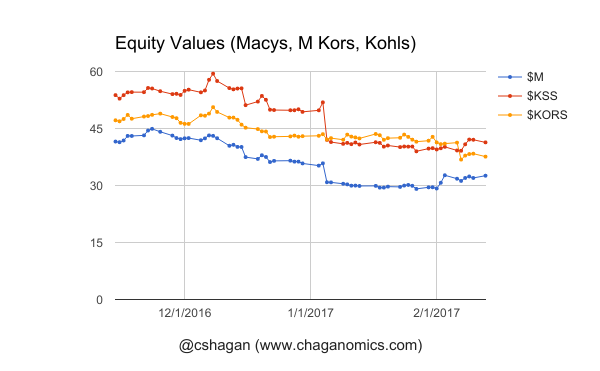
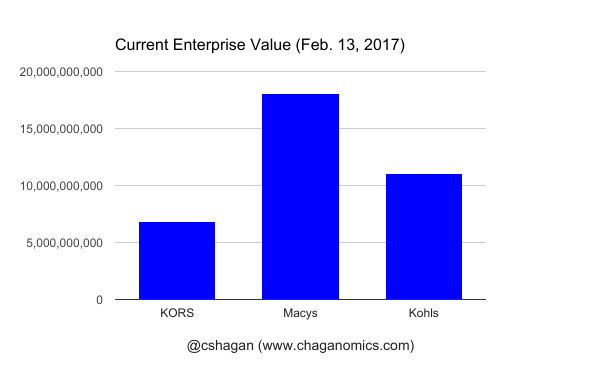
This came up when rumors began around the American Apparel bankruptcy. The idea for American Apparel was perfect. They would buy up the IP and inventory and stores. A seamless integration could begin. If AMZN were to buy M, KSS and KORS $36 billion (give or take) - would this be a good thing?
$36 billion is not going to shake AMZN. Additional questions arise like: Will this hurt AMZN's bottom line? Amazon has a strong history of selling $1.00 for $0.99 (or 98 cents) but how will that equate if they take on additional retail liabilities?


http://seekingalpha.com/user/32088685/instablogs#instablogs

If you were to take Saudi Arabia's religious issues into effect their credit rating should hover on near default. IPO: Saudi Aramco i...

If you were to take Saudi Arabia's religious issues into effect their credit rating should hover on near default.

IPO: Saudi Aramco is valued at $2 trillion. Estimates in 2015 penned the valuation at $10 trillion. Whatever it may be 5% of the group is being listed and the value for that is seen at $100 billion.

Saudi Arabia is scheduled to go bankruptcy in about 5 years. The money will help. This is developing...

From the IMF: Transcript of a Press Briefing On Update Of The World Economic Outlook January 16, 2017

MS. NARDIN: Let's move to our colleagues that are online now. First from Saudi Arabia, and then on Africa. On Saudi Arabia: can you please elaborate on the reasons behind cutting the 2017 forecast even as the expected rise in oil prices provide room for government spending, and what is the forecast for non-oil economy growth in 2017? And another question, if we think the slowdown in Saudi Arabia's economy will impact aid to other countries and investments in the region. 

MR. MILESI-FERRETTI: Well, clearly, Saudi Arabia relies on oil revenues for a very sizable fraction of its exports and its government revenues, and, hence, the impact of lower oil prices on the economy is very strong. And we have seen, indeed, in 2016 a very sharp slowdown in growth. We had growth just of 1.4 percent. The forecast for 2017 depends, of course, on the behavior of both the oil part of the economy and the non-oil part of the economy. As in regard to the oil part of the economy, we have the impact of the agreement between major producers which is an agreement to curtail to some extent oil supply, and hence less oil production is going to mean less output from the oil sector even if prices are a little bit higher. With regard to the non-oil economy, Saudi Arabia is embarking on a very ambitious structural reform program, but also a very sizeable fiscal consolidation because of the decline in oil revenues. So there is a big adjustment in spending downwards. There is an adjustment in taxes upwards, and as a result the non-oil growth is not going to be as buoyant as it was during period of strong oil prices. Clearly, a bit higher oil prices help on the revenue front, but there is a lot of ground to be made in order to close the fiscal deficit that has opened with the decline in oil prices.

Here are some back of the napkin numbers on marijuana revenue. State of Georgia Marijuana Numbers Georgia Population Using at 15% Avera...


Here are some back of the napkin numbers on marijuana revenue.

State of GeorgiaMarijuana Numbers
Georgia Population Using at 15%Average $$ spent per year on MMRevenue & Tax
1,500,000$1,500.00$2,250,000,000.00
$125.00 Per Month Tax at 20% = $112,5M

Dryships is high risk and it has been high risk for a while. The stock has split four times in recent times, and there is no doubt that the...

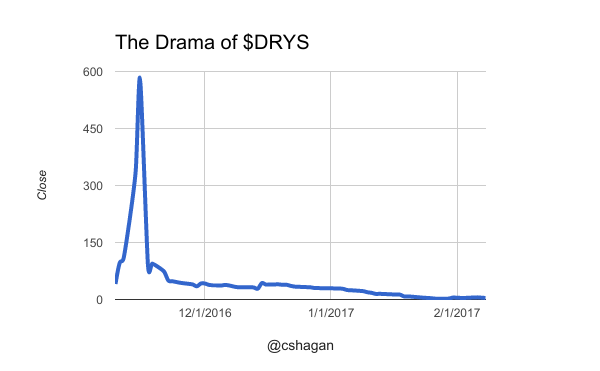
Dryships, Inc. Equity Price

Dryships is high risk and it has been high risk for a while. The stock has split four times in recent times, and there is no doubt that the creditors and bond holders are directing these hands. The percieved pay off would happen this summer - when DRYS recieves new tankers and can take advantage of long term charter rates and stave off losses from the spot market. Given the current rates DRYS will need capital to fund the losses until delivery of the VLGS (Very Large Gas Carriers with 83,000 cubic metres of cargo capacity) in June. However, June's delivery is just one vessel, and DRYS has yet to disclose when the other vessels will arrive.

VLGS are quite large (very large in fact See BP's VLGS Fleet) and the long term rate set in long term contracts will bring needed cash flow to the balance sheet. While this is promising to invest, it is risky. DRYS may be eyed as an attactive equity for the price, but as mentioned the fear is the lack of control equity holders have.

I have attached most recent cash flow, balance sheet and baltic index metrics.

- Chad Hagan

DRYS Gross Income Margin      
Date Gross Income Margin (USD, Percent)
12/31/2016 3.916225475    
9/30/2016 28.80500957    
6/30/2016 -11.27722547    
3/31/2016 -56.5851602    

From Benzinga: All together, each share of DryShips stock today represented 1,200 shares a year ago. The stock has been restructured so many times that it's hard to know which short interest numbers are even reliable. Yahoo Finance recently had DryShips' short percent of float above 160 percent. On a reverse split-adjusted basis, DryShips' 52-week high is $2,227. Today, the stock stands at around $5.30. - Wayne Duggan

* This is an opinionated blog post. Op-ed in fact. It is a bit cynical. Statistical and demographic research has been applied to this a...


* This is an opinionated blog post. Op-ed in fact. It is a bit cynical. Statistical and demographic research has been applied to this analysis.  - CH

Following The Trends

What generation(s) matter? Well, from an aging perspective it is the silent and baby boomer generation. From a mass choice and power side it is the millennials and generation X. Right now the older generations are very easy to track from a consumer spending side. They move in mega trends - or have moved in mega purchasing trends - like marriage, housing and vacation styles.

I must admit, being born in 1980 makes me a bit of an eye roller when it comes to strong stereotypical examples inside older U.S. generations. I find die hard baby boomers and the silent generation to be particularly annoying in my situation.

"Silents" are called that because many focused on their careers rather than on activism, and people in it were largely encouraged to conform with social norms -Wikipedia.

It is important to note that the "Silent' generation never produced a United States president.

As for the boomers and consumer class - These are the guys yelling in public about the price of their new boat dock. Who brags about spending money?
Maybe they use slang like Hemingway characters, or talk about killing people during the war with their bare hands for the old America, not the new. There is a chance they are heavy adherents to the car culture, which I am against for economic and environmental reasons. I never understood the idea of being prompted to buy a car because of an advertisement. Maybe these types buy cars every year - and not just sedans or sports cars - they buy trucks and vehicles that weight four tons. After all oil is good right?

They likely are late bloomers to technology (this is a fact generally, as they did not have tech in the 60's and 70's for the most part,) so they may send your picture out to 10,000 people by accident, or perhaps because they are thrilled at the new technology and the infinite possibilities it seems to bring (like doing things that are incredibly out of touch). They may complain about the younger generations use of technology, which no doubt is a useful way of escaping lock-ins with older generations, and saved the new generations from becoming drab old coots like the older generations.

There is also a chance they were heavily influenced by advertising, which means they were scammed into conspicuous consumption and consumerism that has plagued America, and then on top of it all, created a false system of values built around conspicuous consumption and mass consumerism. Those values may even be the very reason for the subculture inside the baby boomer generation called Generation Jones. Roll your eyes even harder on that one - for there lay the braggarts of America - assuming they "made it" based upon their marketed and pre-packaged ideology.

Yes, the new generations will show the old that there is more to life than conspicuous consumption.

Regardless, take a look at the chart below.

Also, read (a former professor of mine): 
The Myth of the Middle Class - by Richard Parker (Amazon Link)


From Wikipedia:

Western world generation break down:
For the purposes of this list, "Western world" can be taken to include the Americas, Europe, and Oceania. However, it should also be noted that many variations may exist within the regions, both geographically and culturally, which means that the list is broadly indicative, but necessarily very general. For details see the individual articles. 

The Lost Generation, also known as the Generation of 1914 in Europe, is a term originating with Gertrude Stein to describe those who fought in World War I. The members of the lost generation were typically born between 1883 and 1900. 

The G.I. Generation, also known as the "Greatest Generation'", is the generation that includes the veterans who fought in World War I. They were born from around 1901 to 1924, coming of age during the Great Depression. Journalist Tom Brokaw dubbed this the Greatest Generation in a book of the same name. 

The Silent Generation, also known as the Lucky Few, were born from approximately 1925 to 1941.
It includes some who fought in World War II, most of those who fought the Korean War and many during the Vietnam War.

The baby boomers are the generation that was born following World War II, generally from 1946 to 1964,a time that was marked by an increase in birth rates. The term "baby boomer" is sometimes used in a cultural context. 


Generation X, commonly abbreviated to Gen X, is the generation following the baby boomers. Demographers and researchers typically use starting birth years ranging from the early-to-mid 1960s and ending birth years ranging from the late 1970s to early 1980s. The term has also been used in different times and places for a number of different subcultures or countercultures since the 1950s. 

Millennials, also known as the Millennial Generation or Generation Y, are the demographic cohort following Generation X. Demographers and researchers typically use the early 1980s as starting birth years and ending birth years ranging from the mid-1990s to early 2000s.


Copyright 2008 - 2025

(C) Atlantic Playbook / ZMI